7th and 8th Graders? They're Just Like Us (Mostly)
Explore the trainingThis training is proprietary to my employer. The version linked here has been recoded and unbranded for portfolio purposes. Proprietary resources have been redacted.
Context & My Role
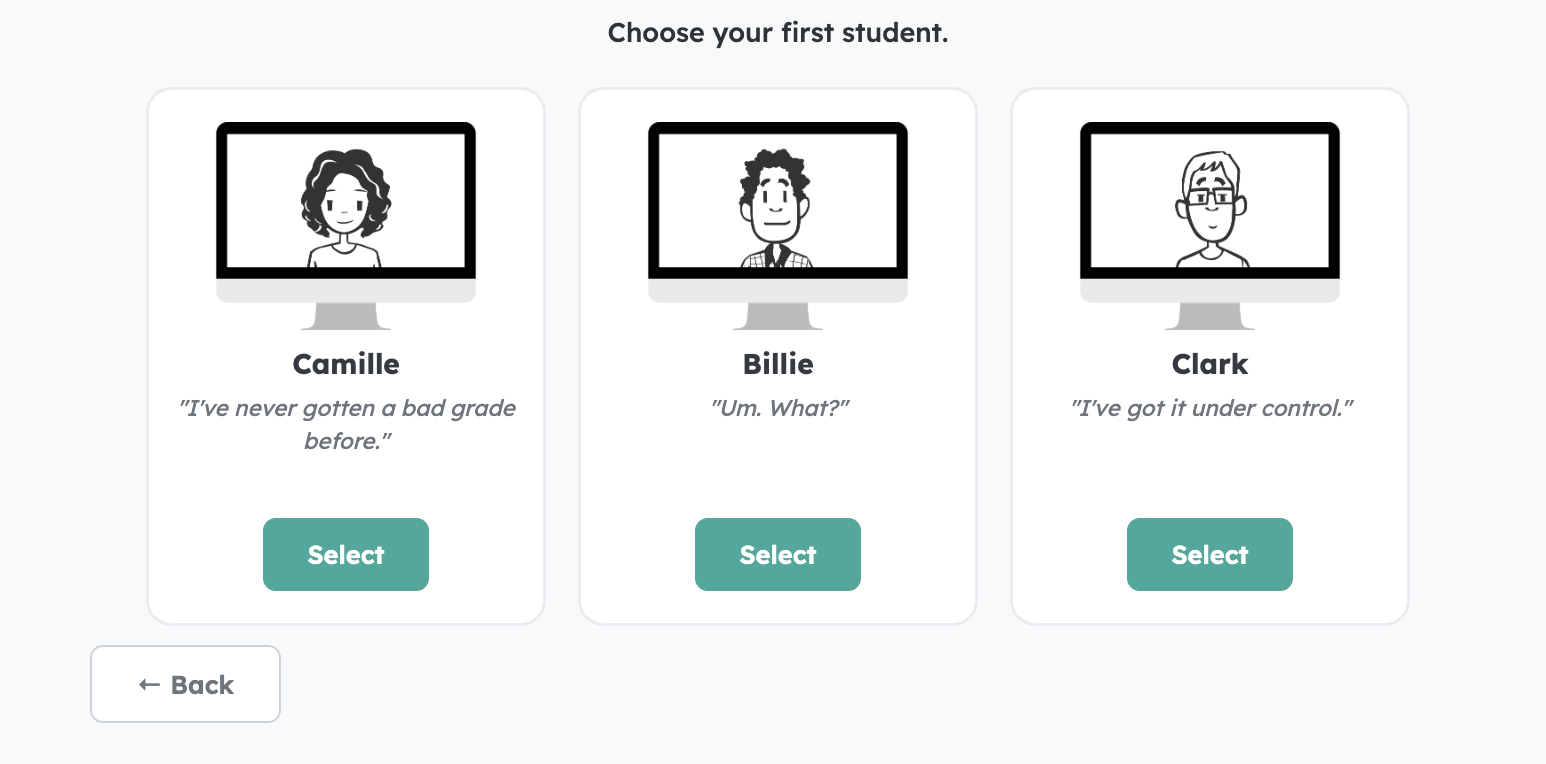
At an online secondary school serving grades 7 through 12, I led a team of three colleagues to create, "7th and 8th Graders? They're Just Like Us! (Mostly)," an interactive HTML training for staff new (or returning after a hiatus) to working with this age group. The school had previously staffed 7th and 8th grade with a dedicated team; under our new model, all staff now work across every grade level, and many colleagues were a bit anxious. The training's core message is in its title: 7th and 8th graders struggle with many of the same things as high schoolers (and also adults!). That shared humanity is exactly what equips our staff to work with them well. Built around three detailed student profiles—Camille, Billie, and Clark—the training uses Claude-powered practice conversations so learners can rehearse real 7th and 8th grade scenarios and receive a personalized debrief evaluated against our school's core values. My teammates gave me the go-ahead to take the lead on the project given my instructional design background. I developed the vision for the training, held the timeline, directed the video script and creation of content to feed the Claude bot, and designed and built the tool in Claude Code.
The Problem Worth Solving
Under the school's previous model, 7th and 8th grade students were served by a dedicated team; under a new model, all staff now work across every grade level. Some staff were nervous about the shift. What they actually needed was permission to trust the skills they already had, and a live demonstration that proved the strength of those skills.
My Strategic Approach
The training opens with a video featuring me and two teammates who had previously worked exclusively with 7th and 8th graders, speaking directly to how brain development at this age affects executive functioning and how parent involvement tends to look different. I wanted staff to have that context explicitly, before anything else, because it's the "mostly" in the title made real: the message is that 7th and 8th graders are mostly like us, not identical to us, and staff needed to hear where the real differences are before the training could ask them to trust their instincts.
I split the practice scenarios into four pathways by role, Student Support Specialist, Student Advisor, Teacher, and Academic Counselor, and had my colleagues from those roles—subject matter experts—develop the scenarios. I built the debriefs to be short, skew positive, and evaluate learners against our school's core values rather than a right-or-wrong standard, because the goal wasn't to catch people making mistakes, but to hand them proof that they already had what this age group needed.
The Learner Experience
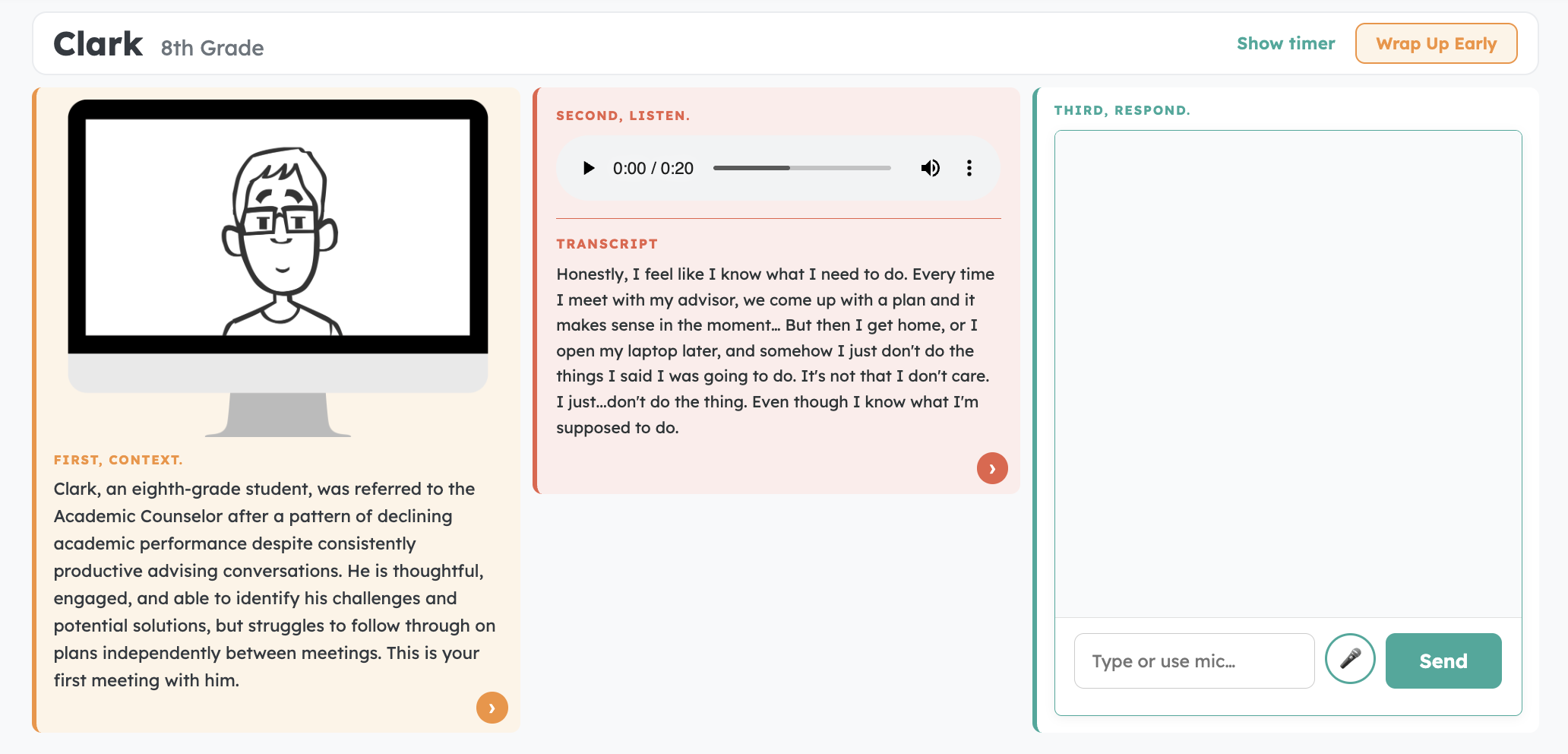
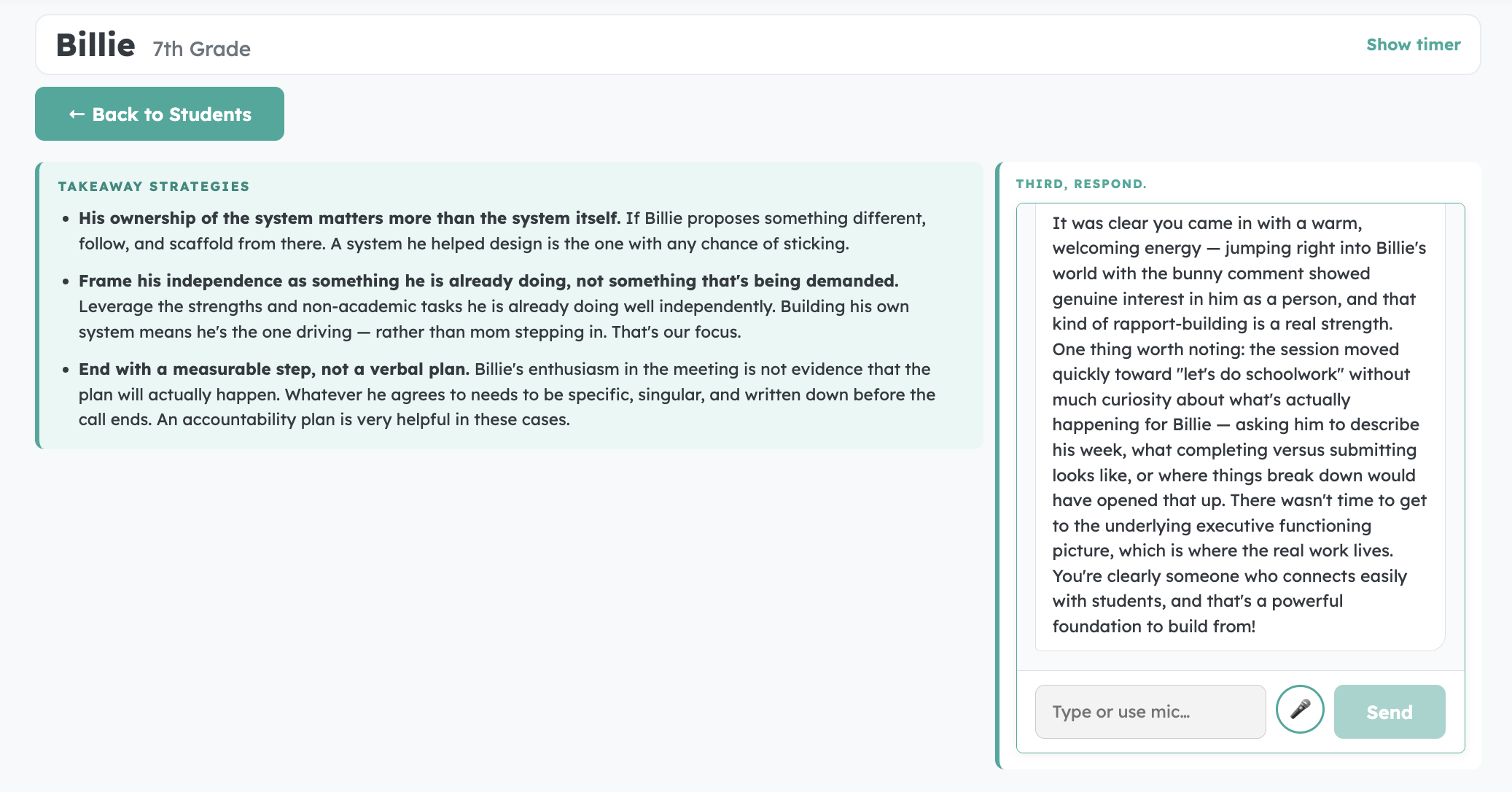
After the intro video, the learner picks a pathway based on their role and lands in a scenario grounded in their actual job. Some learners had worked with 7th and 8th graders before, some never had, and for others it had simply been a long time, but the scenario isn't asking them to learn something new so much as prove to themselves that they already know how to do this. Each scenario opens with a short audio clip (created in ElevenLabs) of either the student speaking or a parent or staff member talking about the student, so the scenarios feel real. Some of the clips are pretty funny because 7th and 8th graders can be pretty silly! From there, the learner talks through the situation with the student, played by a Claude-powered bot, either by typing or speaking into a mic, whichever feels more natural, in a conversation built to run about fifteen minutes that plays out differently every time. The debrief that follows names what the learner did well before what to adjust, and closes with concrete takeaways they can carry into a real scenario.
A structured reflection section closes the experience, asking learners to consider what they noticed about themselves in the students they'd just met, and a Google Form sends them a copy of their own responses to revisit later. All videos are accurately captioned, with captions optional, so the training works for all learners.
From Design to Delivery
We built this in about a month against a hard deadline for back-to-school training, which made project management a key part of the work in addition to content development. I kept a working doc with clear individual tasks and deadlines so every teammate knew what they owed and when, since the bot needed a large volume of scenario content to convincingly impersonate three different students across four roles. We recorded the intro video live over Zoom, then spent significant time training the Claude bot on each role's scenarios so it would respond in character. I provided feedback and support as my colleagues built out their pathways, provided structures for testing, and worked to fix the glitches and errors testers identified.
Results & Reflection
I'm still new to leading a team through a creative project, and I was eager to grow those skills. I asked my three teammates for feedback afterward. They said I communicated clearly, kept expectations crystal clear throughout, and that the work was engaging and meaningful. One piece of feedback stuck with me: a colleague said she hadn't felt much creative autonomy on the project, but clarified she didn't actually want a lead creative role either. She asked me how I might balance creative leadership on a project with another "Allie"—in other words, someone else just as excited and vision-driven as me. A good question, and one I'm carrying with me.
Twenty-seven staff completed the training, and a pre- and post-training survey shows average confidence working with 7th and 8th graders rising from 3.6 to 4.3 on a five-point scale. The reflection section centers on the training's guiding idea: "7th and 8th graders aren't a different species. They're human too. Did you see yourself in any of these students?" All but two of the 27 respondents wrote about seeing themselves in at least one of the three students; of those two, one wrote instead about seeing her own son in them. Camille was, it seems, the most relatable of the three for this audience, with 15 of 27 respondents writing about seeing themselves in her. One respondent wrote: "What sticks with me most is that 7th- and 8th-graders aren't fundamentally different from older students or adults; they're experiencing many of the same emotions, just with less experience navigating them." I feel confident that this training persuasively lands its thesis: 7th and 8th graders aren't that scary—they're human, just like you and me!