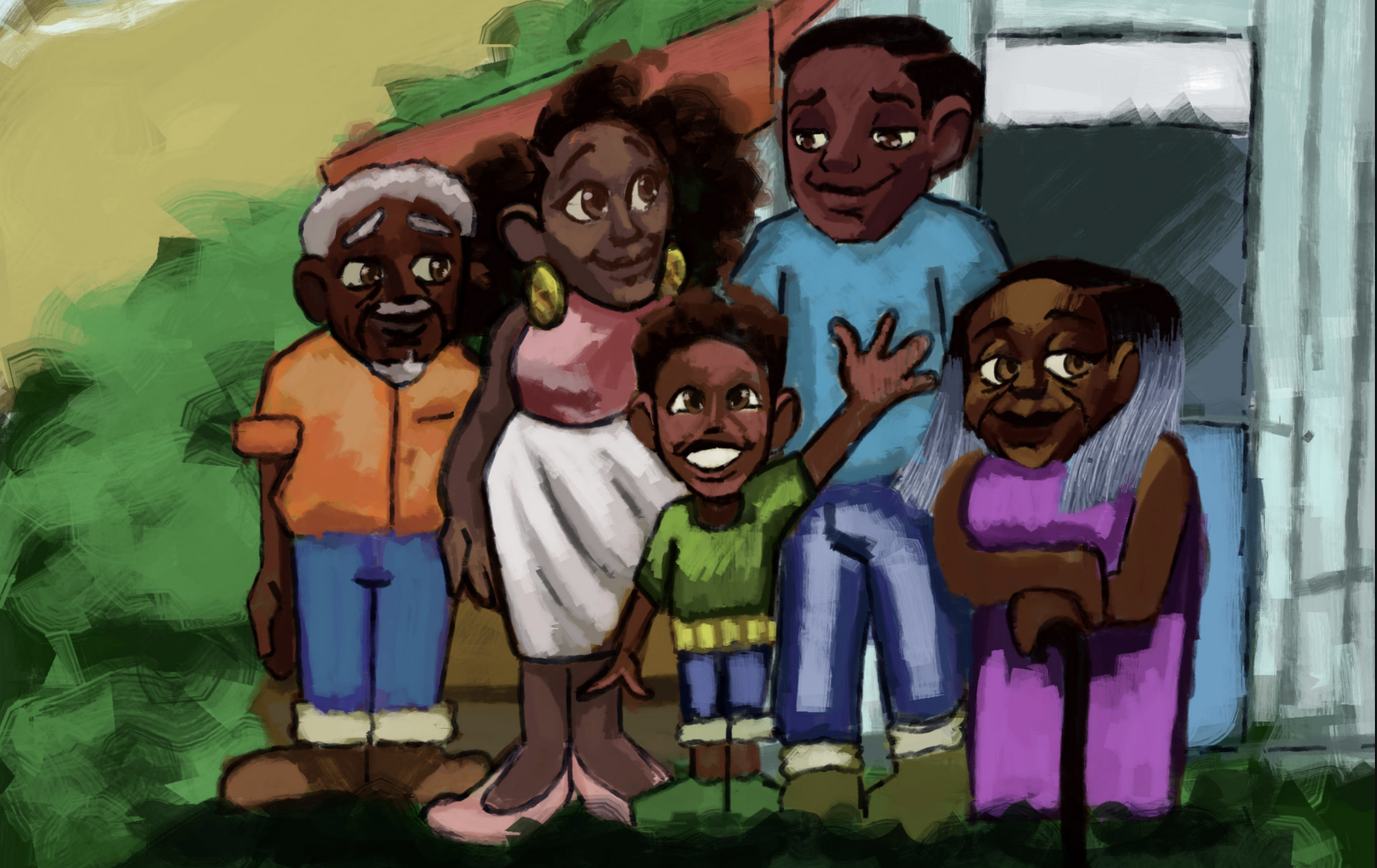
From Emmanuel's Rocking Rhythm. Illustration by Gabrielle Burnett
Culturally Responsive Readers
Read Books
Context & My Role
I came to this project as a volunteer at Project Esperanza's Change My Stars Camp in Puerto Plata, Dominican Republic, a summer program for Haitian students. I noticed that the reading materials available to students didn't reflect their lives, their communities, or their identities. I knew the solution was culturally responsive readers, but I also knew I wasn't the right person to write them. What I could do was see the project through. I had the execution instincts, the network, and the ability to get people excited about a mission.
I served as project manager, coordinating a volunteer team across multiple institutions to bring six original illustrated short stories from concept to the hands of Haitian students in the Dominican Republic. The books are currently in use at Project Esperanza, and this summer they will be accompanied by comprehension worksheets.
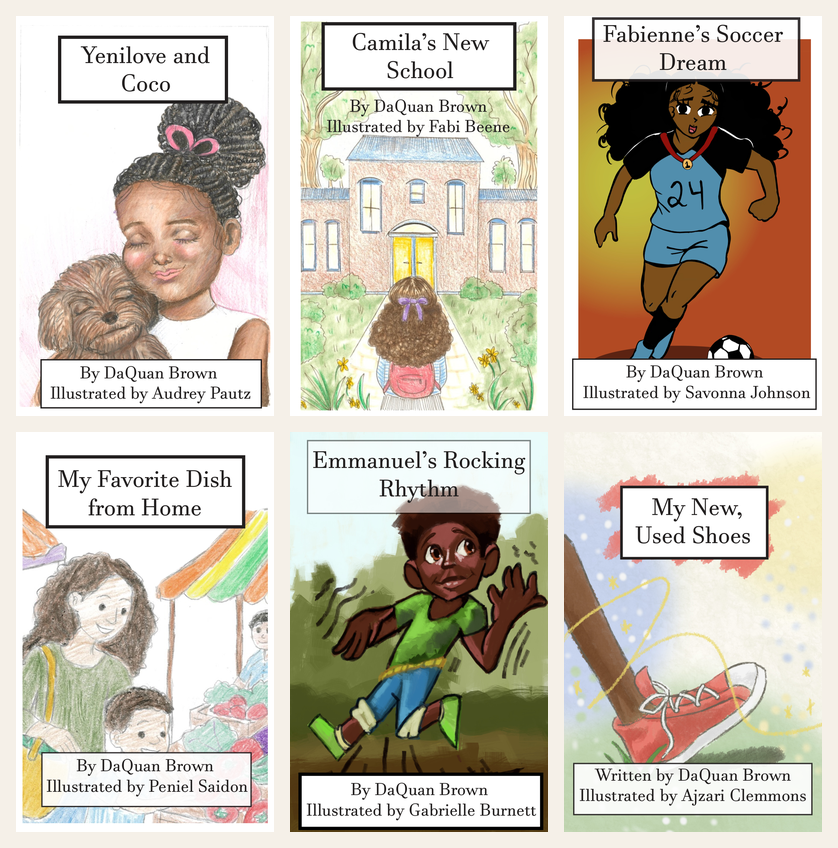
All six culturally-responsive readers
The Problem Worth Solving
Children's reading materials at the camp were disintegrating, literally and figuratively. The humidity in Puerto Plata destroys paper, and the existing books weren't built for the climate. But the more significant problem was representational. The characters, settings, and experiences in the available materials had no relationship to the lives of the students reading them.
I know from years of teaching multilingual learners what it costs a kid to never see themselves in a book. It tells them that their stories don't matter — that they aren't important enough to put in print, that the questions they're asking about the world are irrelevant. I went to great lengths to solve that problem in my own classroom, hunting down texts that reflected my students' lives and identities. When I arrived at Change My Stars and saw the same absence, I knew I had to do something about it here too.
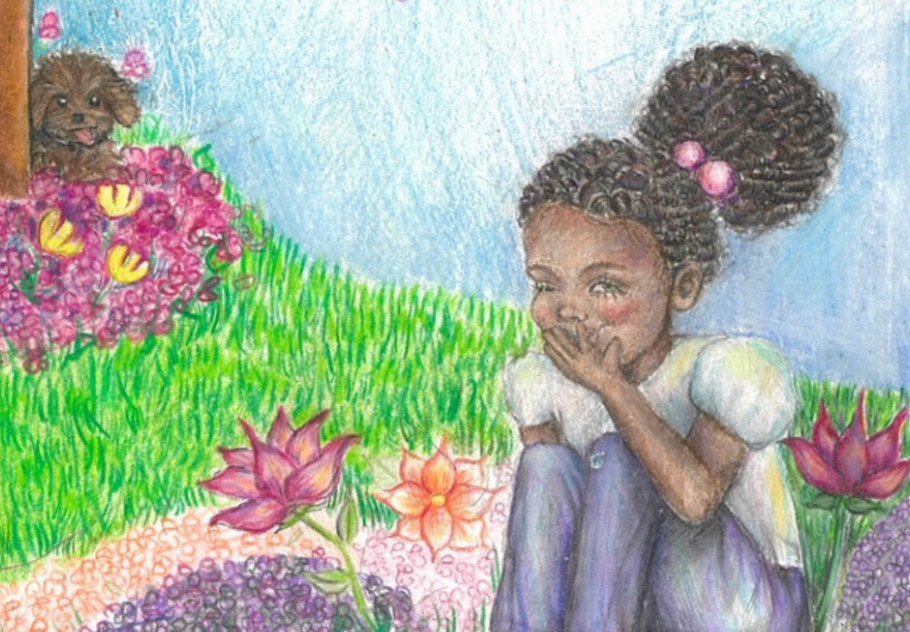
From Yenilove and Coco. Illustration by Audrey Pautz
My Strategic Approach
The most important decision I made on this project was about authorship. As a white woman, I wasn't the person to write these stories. The students are Haitian; I wanted the author and artists to be Black, even knowing they wouldn't share the students' exact cultural background. Through the executive director of Project Esperanza, I connected with Daquan Brown, a senior at Morehouse College who had previously written a children's book. He wrote all six stories.
For illustration, Daquan's fraternity connections led to Spelman College, where a student leader in the art department recruited two fellow artists to the project. For the remaining three, I went to my own school network and recruited high school students from Lincoln School, where I was teaching, and got them excited about the mission.
Our small bucket of funding came through an email to Morehouse's office of giving; they provided a grant to cover printing and getting the books to Puerto Plata. One detail I insisted on: humidity-resistant materials. I had seen what the climate in Puerto Plata does to paper, and I called around to multiple printers until I found one who could produce books built to last in that environment.
Getting the books to the Dominican Republic required its own logistics chain. I connected with a volunteer who was traveling there that summer, had the books printed near her location, and coordinated the details of pickup, reimbursement, and transport.
The Learner Experience
The students at Change My Stars Camp range in age from 5 to 16 and bring an extraordinary range of language backgrounds and literacy levels. Many are multilingual — speaking Haitian Creole, Spanish, or both — and many arrive with limited literacy in any language. The diversity of this population is profound, and it means that a single set of six readers can only ever be a starting point.
The books were designed to center characters and settings drawn from the students' own community; we wanted children to open the books and see themselves. The stories use simple, high-frequency English to meet students at the early stages of language acquisition. The comprehension worksheets developed by another volunteer — a former Spanish teacher with deep experience in language acquisition — give college student facilitators a structured guide for engaging students with the vocabulary and content of each book, even without a teaching background.
It is a start. But six books, aimed roughly at a middle range of this population, are nowhere near sufficient to serve every learner at Change My Stars. In an ideal world, this would be a full library of readers calibrated to different ages, literacy levels, and language backgrounds, so that no child is handed something that feels too easy or too hard, and no student's language is left out. We were constrained by time, money, and the limits of an all-volunteer project. I wish we could do so much more.
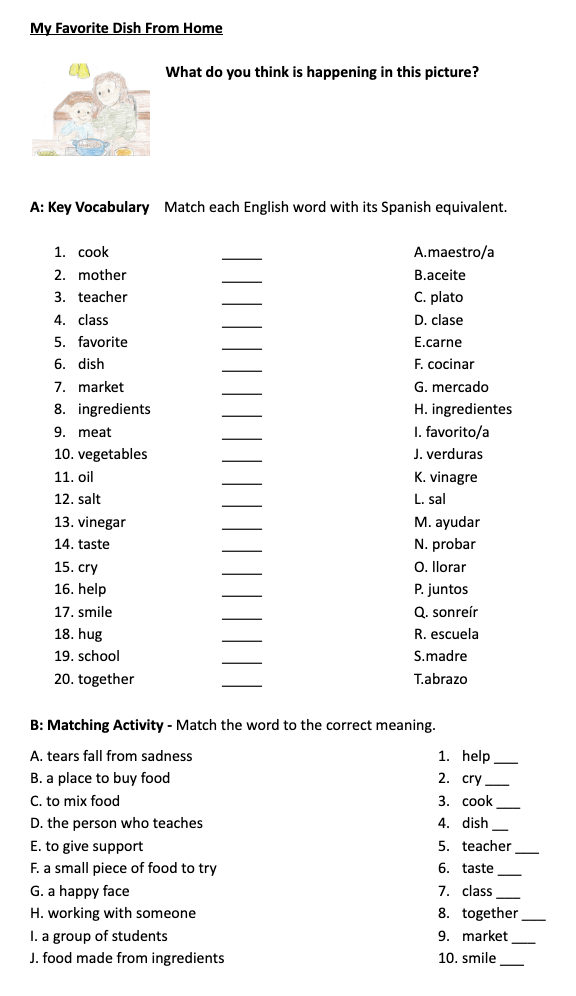
Worksheet for My Favorite Dish from Home
From Design to Delivery
Managing a fully volunteer team across multiple institutions — with no budget for contributor compensation and a hard deadline set by camp season — required constant attention to motivation as much as logistics. For the high school illustrators, I left encouraging notes and treats in their school mailboxes. For the Spelman artists, I tried to stay responsive to the rhythms of their academic calendar while still holding the timeline.
Daquan was finishing his senior year at Morehouse and wrote all six stories on top of a full course load — a real act of generosity that also defined the limits of what I could ask. As an editor in an all-volunteer relationship, I could offer feedback and encouragement, but I couldn't run the kind of revision cycle a paid engagement allows. And this project was a difficult one under any conditions: writing a single set of readers calibrated to a population spanning ages 5 to 16 and multiple home languages, against a fixed camp deadline — that's a lot!
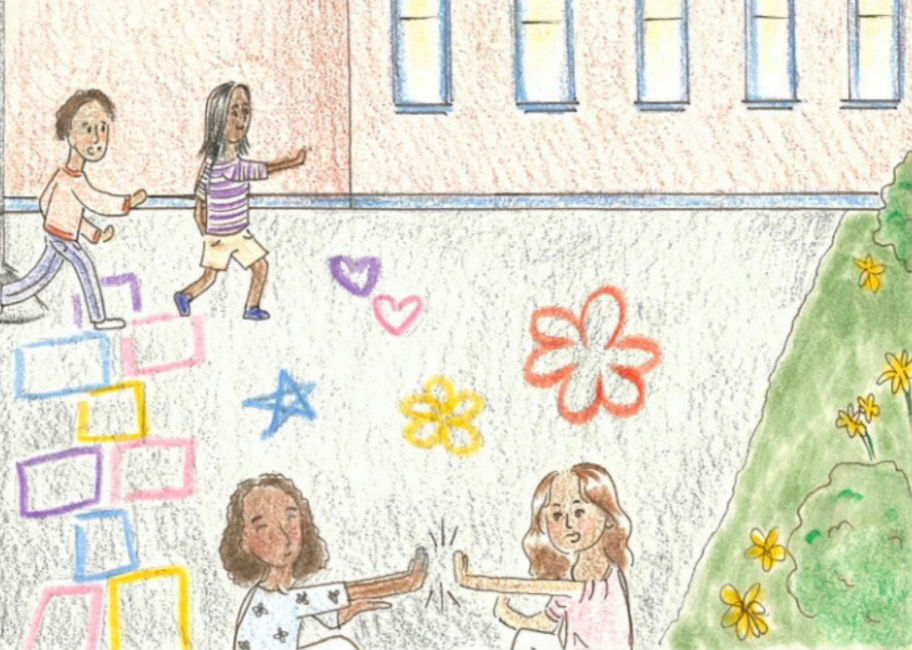
From Camilla's New School. Illustration by Fabi Beene
Results & Reflection
Six illustrated, culturally responsive readers now exist for the students at Change My Stars Camp. They survived their first summer in Puerto Plata. This summer, they go out with worksheets for the first time, meaning volunteers now have a structured tool for facilitating engagement with the books.
I've thought about this project a lot. It revealed a real gap in my practice. I brought my white, western, deadline-centered communication style into a collaboration with a team whose cultural context called for a different approach. After some tension arose, I initiated a frank conversation with a colleague who leads DEI work at a national organization, and she helped me name the dynamics at play and understand where my defaults were getting in the way. I know this is an area where I have work to do. Communicating effectively across lines of difference is a competency I'm still growing.
Second, I learned what project management looks like without financial leverage. Volunteer contributors gave generously, and the project exists because of that generosity. But a stipend — even a modest one — does more than compensate; it creates a reciprocal accountability that helps everyone involved. It gives a coordinator standing to ask for a revision, and it gives a contributor standing to ask for time, scope, or support in return. Next time, I'd build even small stipends in from the start, so the working relationship has that mutual footing.
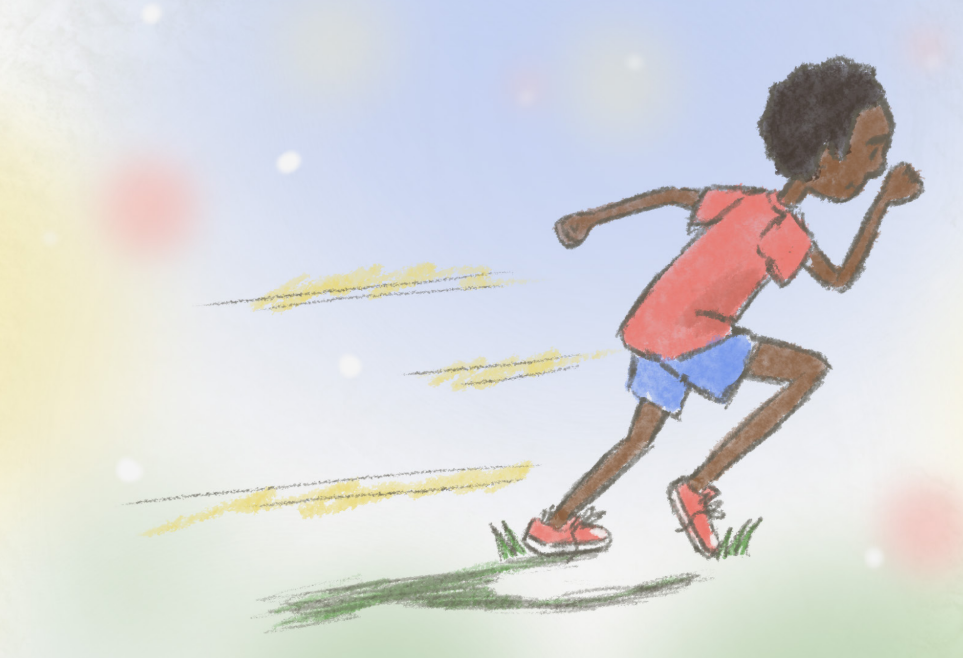
From My New Used Shoes. Illustration by Ajzari Clemmons