Illustration by Colbe Schicatano
The Importance of Being Earnest
Explore the Unit“Allie makes collaborative spaces crackle with possibility. She has a characteristic way of bringing together philosophy and practice—not losing sight of trends and patterns, of principles that underpin our work, but making the next right move that will serve a student in any given situation. She is someone you want to help you think through a dilemma.”
Context & My Role
I designed this five-week unit while teaching grades 8 and 9 English at Lincoln School, an independent girls' school in Providence, Rhode Island. It is one of the units in 🔗 a full grade 8 and 9 ELA curriculum I developed over years of classroom teaching, which I now sell to other teachers. The unit guides students through Oscar Wilde's The Importance of Being Earnest: it builds Victorian cultural context, develops a robust understanding of satire, and culminates in student-written and performed mini satire plays that turn a critical eye on the modern world. What makes this unit different from my others is the message that I try to send home about artificial intelligence: AI doesn't have to control you; keep your brain turned on, and you be the boss of AI.
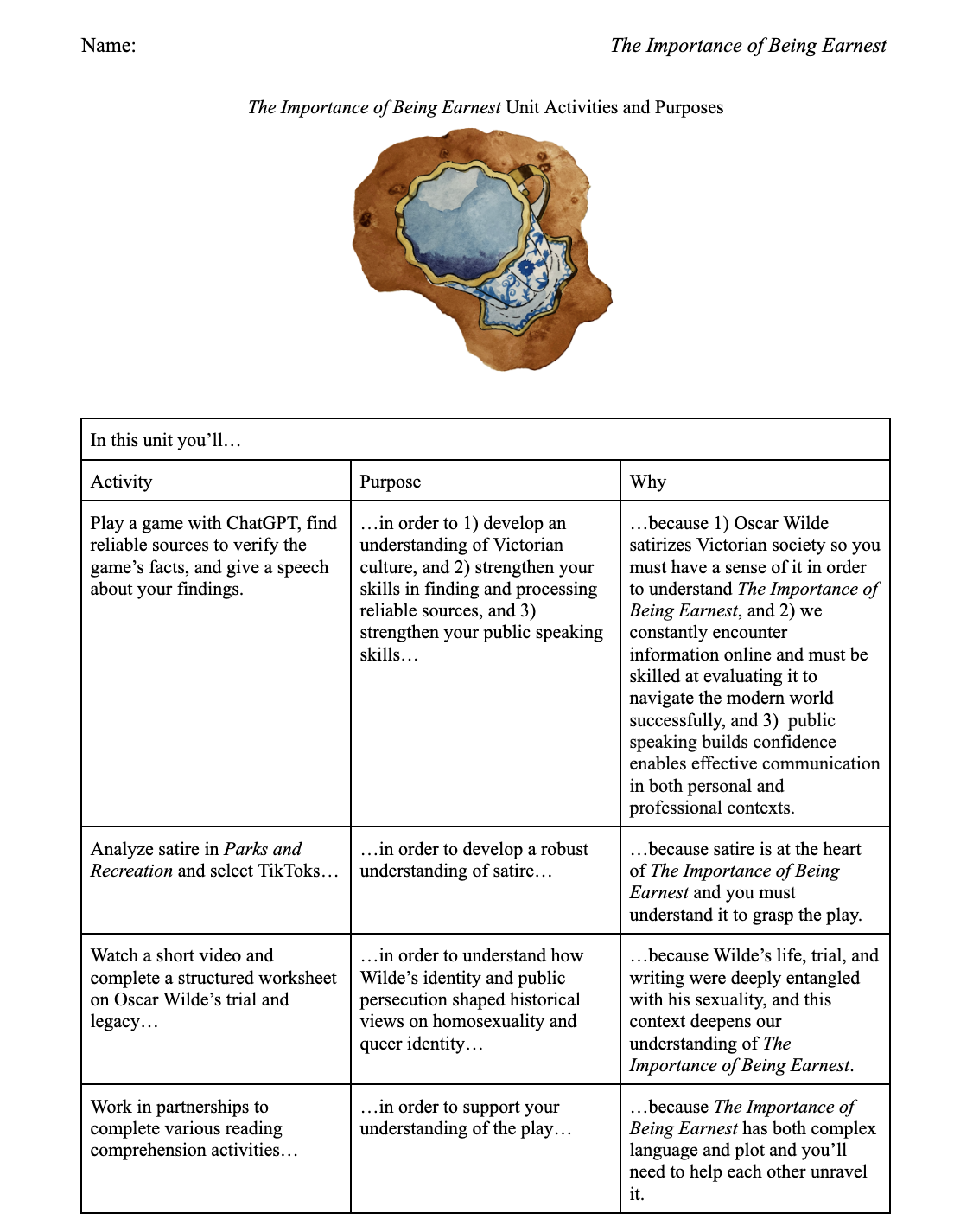
Unit Tasks & Purposes—I always tell learners what they're learning and why
The Problem Worth Solving
To appreciate Wilde's jokes and jabs, students need a real sense of Victorian culture, and they need to understand satire not only as a literary term, but as a living tool for speaking truth to power. The challenge was connecting a nineteenth century comedy of manners to the lives of contemporary teenage girls.
I was also watching students struggle with AI. Some avoided it entirely out of fear or distrust. Others leaned on it so heavily it replaced their own thinking. Neither relationship was preparing them for the AI-saturated world they would enter after graduation.
But I saw an opportunity: AI could be the entry point into Victorian England, a way to connect their world to the foreign past.
My Strategic Approach
Here's how I used the AI: I gave each student a Victorian character — spanning social class, gender, and age, with a life goal rooted in historical reality — and asked them to have ChatGPT build them a choose-your-own-adventure game to help their character navigate Victorian life. The game exposed students to a wealth of details about rigid Victorian manners in a way that was genuinely fun. What the heck is an escort card? We giggled.
The game was just the starting point. Students then picked up a thread from their gameplay and dove into serious research using credible, expert-reviewed sources before delivering a speech to share their findings with the class. From their research and their classmates' speeches, they began to make sense of Victorian England. It started to click why Wilde would want to make fun of it — and then we started to talk about how much of our own context was ripe for satire.
Education researcher Rebecca Winthrop writes that AI platforms can "feel like immutable forces — delivered 'from on high' by large tech companies." I wanted my kids to believe their voice can shake any force that feels immutable. In my classroom, Wilde showed us one way of speaking truth to power — and ChatGPT launched us into Wilde. We were making the tool work for us, not the other way around.
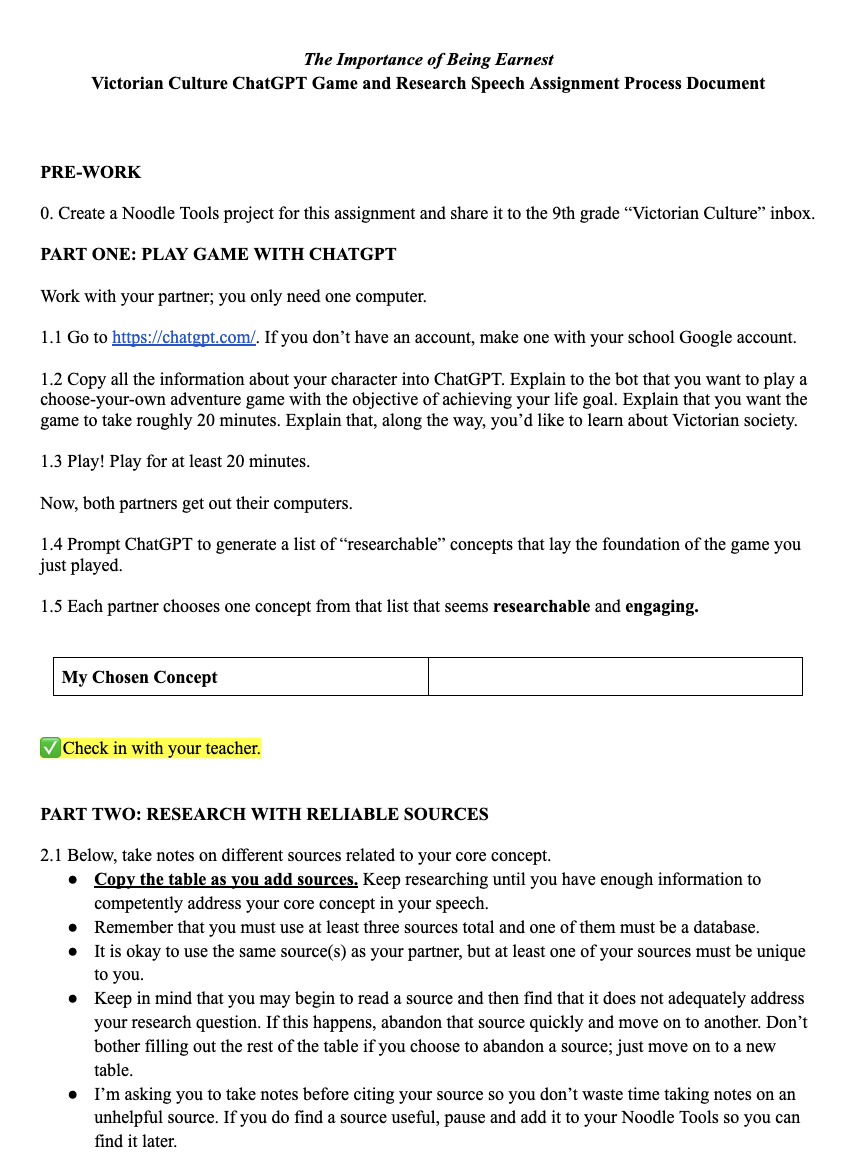
Process document to guide students through ChatGPT game, research, speech development, and delivery

The Learner Experience
This unit enacted my core pedagogy. In my About Me, I write that I built my classroom curriculum around two ideas: that English class should teach the language of power and the language of the heart. This unit asked students to build real skills — literary analysis, structured discussion, argumentation — and then use those skills to say something true about the world they actually live in. That feels especially important for girls, whose voices are so often sidelined. The culminating satire plays were where the language of power and the language of the heart converged; students used their deep understanding of satire to speak up about something they cared about.
From Design to Delivery
This is distinctively an end-of-year unit. By the time students arrived at The Importance of Being Earnest, they had spent the whole year working on two core skills: structured literary analysis writing and discussion. The yearlong essential question — What masks do we wear? — had thread through everything we'd done. Wilde, with his fake identities and hidden queer life, was the culminating answer to that question.
I built the scaffolding system students used in this unit across the entire year, not just for this unit. I used the same discussion rubric from September, giving feedback on it again and again so students could track their own growth. I introduced the writing support resources — the Polish Process, How to Integrate Quotes, What is Analysis? — slowly, one at a time, across earlier units. By spring, students weren't learning these tools, but really putting them to use in service of their own arguments.
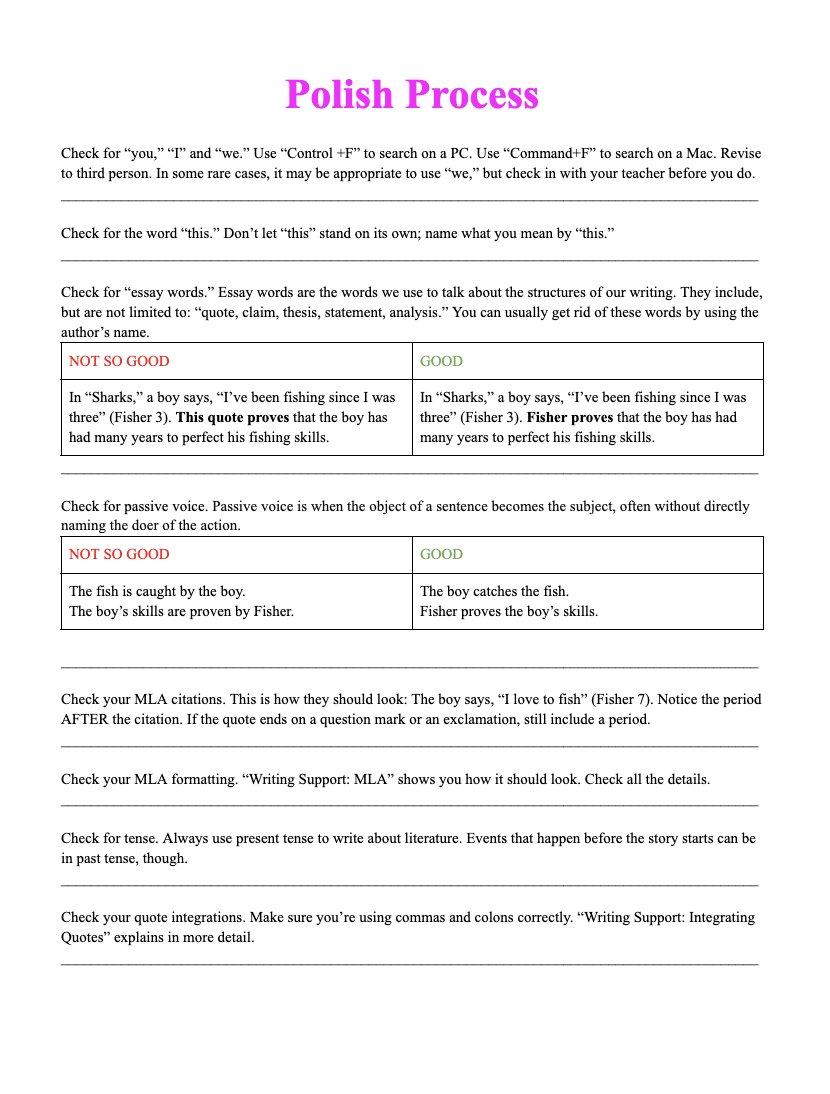
The Polish Process steps students through polish edits before submitting writing
Results & Reflection
This unit lived in my real classroom. Students wrote satire plays about social media addiction, performative wellness culture, and even AI. They made connections between Victorian marriage markets and modern dating apps. They laughed at Wilde and then laughed at themselves, which is exactly what satire is supposed to do.
After teaching the unit the first time, I went back and added something I had been missing: a queer lens. It was only after watching the National Theatre Live production of Earnest, which puts drag front and center, that I understood how much queer coding was woven into the play and how essential it was to name it. I revised the unit to reflect that. A queer lens, like a satirical lens, is a tool for seeing the world differently — for questioning what we're told is normal and exposing the absurdity underneath. That is exactly what this unit is about. I see the two lenses as analogous: both ask us to look at power, at performance, at the masks we wear. Wilde was doing it in 1895, and we need it now more than ever.
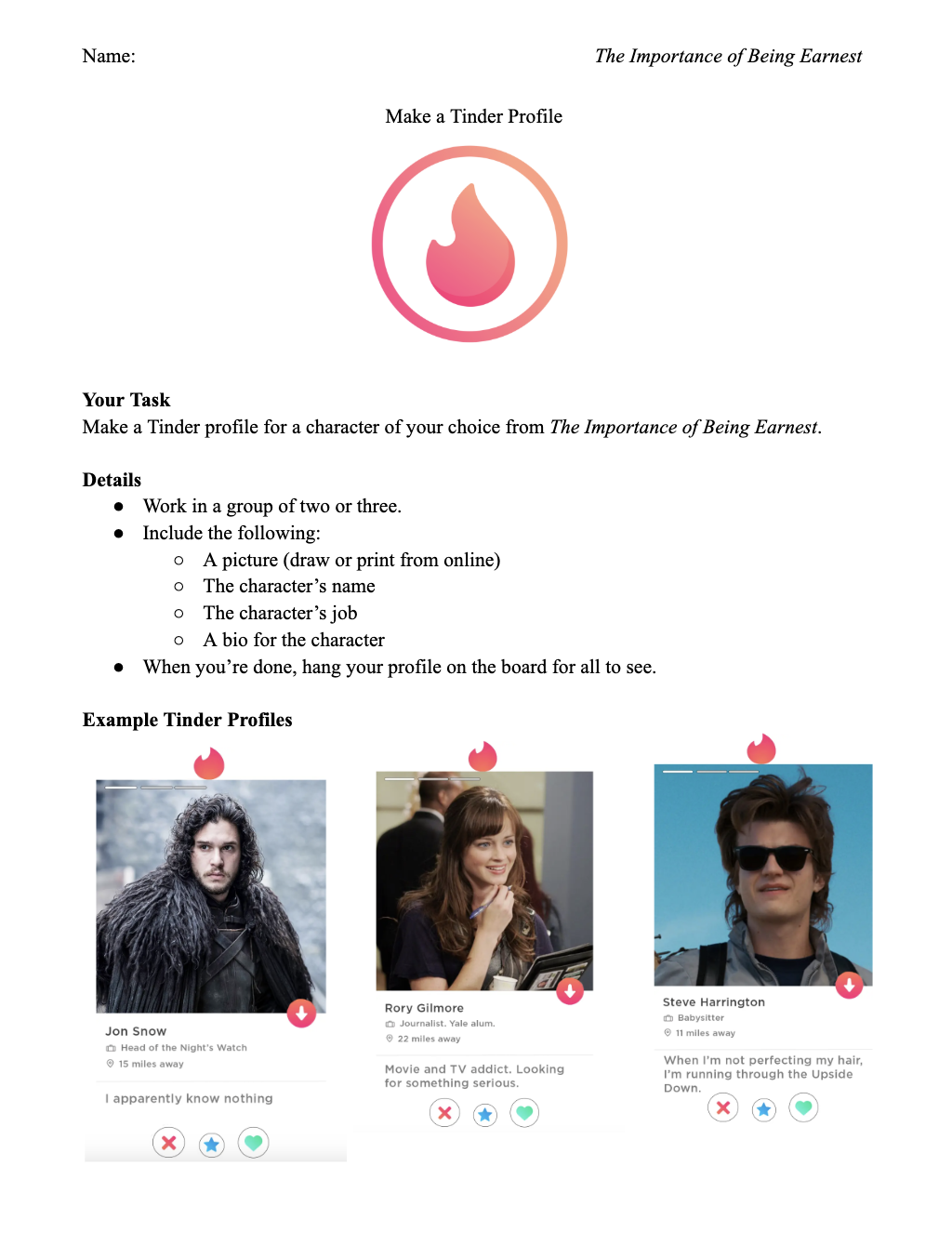
Tinder profiles for characters!